Saturday, June 15, 2019

Fairbanks....Heart of Gold

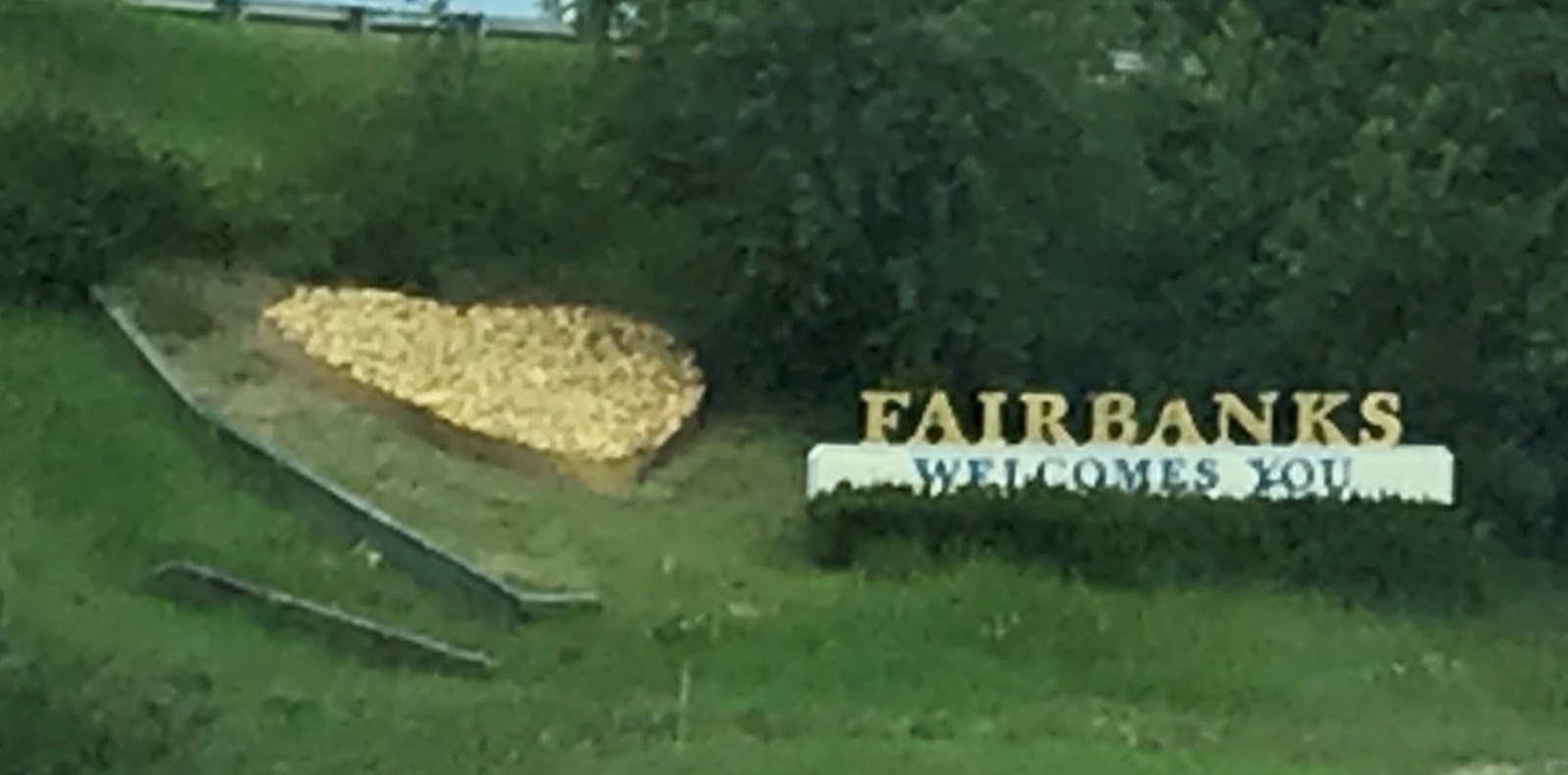
Hi all....welcome to Fairbanks, city with a heart of gold!
It's actually called "Heart of Gold" city. Gold was found here around 1902, and then she grew up, literelly. There are a lot of things to do here in Fairbanks. We stayed at a nice park about 10 miles out of Fairbanks proper. The downtown is quaint and has a lot of good eateries. There are a lot of Asian-inspired places here. Of course, Russia is only 50 miles away! (not from here, though). So let's re-cap some things we did here.
DAY ONE:  took a ride on the Riverboat Discovery.
It is a sternwheeler paddleboat that goes up and down the Chena River. It weighs 23,000 tons and only needs 39 inches of draft. The boat runs 4 months a year; in the interior of Alaska, the summers are short. The river has a complete freeze by Halloween. About 1 in 7 people in Alaska have one of these:
Yup! They are licensed pilots. Gotta have a way to get around in remote places. Behind him is the original Discovery (we were on Discovery III). It only carried 26 passengers. A husband and wife came up with the idea to show people the wonders of the river, and a trade (tourist, that is) was born.

There are many Alaska First Nations here, but the predominant one in the interior is Athabascan. They learned to use the land and every bit of the animals they hunted to survive up here. They had moose, caribou, bear, fox, timber wolf, beaver, and ermine. They used the pelts for warmth, the meat for food, and their skins for clothing. They also used their sinews for binding. Trees, like birch, were made into canoes. And of course, salmon runs. The salmon would come up the river. King salmon were eaten by the people. Chum salmon were given to the dogs.
This guy posed for a picture

Fish wheel:  it spins in the water, trapping the fish in the net. Voila! Dinner!

Learned about mushing at this place; his wife, Susan Butcher, won 4 Iditerods; she died in 2006 of leukemia. She wrote a book, Granite, about her favorite dog. The dogs above descended
from Granite.

DAY TWO:  visited LARS:  Large Animal Research Station. Learn about Reindeer and Muskox. This is part of the University of Alaska/Fairbanks campus. Students come here to learn about the animals. They are harnessed early and learn to work with humans. The muskox come from a group from Greenland that were shipped over to Alaska. The reindeer come from a line from Siberia. Nice to trace your lineage that far, eh? 😊
They harvest the undercoat of the muskox, called quivit (pronounced "kiveeit"). They weave it, spin it, and hand dye it; then they sell it to you for $120/200 yds. I love you, LH and mom, but even I won't buy one for me. Apparently, it keeps you warm in -20*F below. Who knew?
From this
To this

DAY THREE:  Pioneer Park. This is a walker's paradise. Wide streets, dog walker's haven (NS--you and Dunkin would LOVE it!). They took a lot of the cabins that were on the streets of Fairbanks and turned them in to shops along the paved road area. Along the way is old gold mining equipment, too. So you get to meet crafters/vendors. There are plaques on the outside of the houses to tell you who used to live there, what is was used for, etc. Just a neat place to take a walk through history. We were there about 30 minutes. Oh, by the way, it's FREE!!!


DAY FOUR:  Morris Thompson Cultural And Visitors Center. This place is jam-packed with wonderful things about Alaska and Fairbanks/Interior of Alaska in general. And not one penny comes from tax-payer money. It is all funded by donations! There were many movies to watch. We got to see one about Alaska in general and one about the northern lights (they only happen between August and March). There was also a wonderful exhibit where you walk through the four seasons of interior Alaska. They also had some great outdoor critters you are likely to meet, like this guy:
He doesn't look happy that I took his picture.

I think I might have gotten too close to this one!

Fish camp; little critter is greedy!

This was a great map I could read; not sure if you can zoom in, but it shows all the First Nations and where they all inhabit in the state of Alaska.

Outside of each of the entrances to the center (I think there are 6) are mosaics like this one. How beautiful! They copy some type of motif.
This is one type of artwork I am leaving to the experts and not trying on my own!
They are all seed beads.

DAY FIVE: 

The name says it all! It is a museum that showcases AMERICAN automobiles from 1898 to the late 1930s and the vintage clothing that went with them. It really was a hoot! There was even a section of cars that were in Alaska during that time. They even had electric automobiles, so this concept is not new. I was quite impressed. And they told us that all of them ran well, except for 3. Not bad at all. Here are some of the gems.
A motorized "surry with the fringe on top" (a motorized cab with fringe)

 
1909 Cadillac

1917 Pierce Arrow

What you'd wear in the Pierce

1936 Packard----a touring automobile

Looking stylish as you ride in your Packard

DAY 6: University of Alaska/Museum of the North. This is housed at the actual college campus. 

It had a lot of interesting exhibits, including this neat one here:
First ever Polar Dinosaur---pretty cool, literally!

My favorite part about this museum lay in the back, the Alaska section. You start at the beginning of Alaska, with its First Nations/Eskimos and Tlingits, and walk to the end, World War II to present. It was really spectacular! I am reading this book
And it seems like the entire exhibit followed this book! It was fantastic! I was able to follow along and understand it! It was great to see some of the stories in the book come to life in the exhibit. For example, one of the characters in the early part of the book has to get sent to the Pribilof Islands (also known as the Seal Islands) as punishment for wrongdoing. Consider it being sent off to prison camp. Here is what he would see at the islands
And the background in the picture is basically all they would see for miles. It was extremely cold and windy, since they were surrounded by water, and storms were frequent. But, if you're gonna do the crime, you gotta do the time. 😏
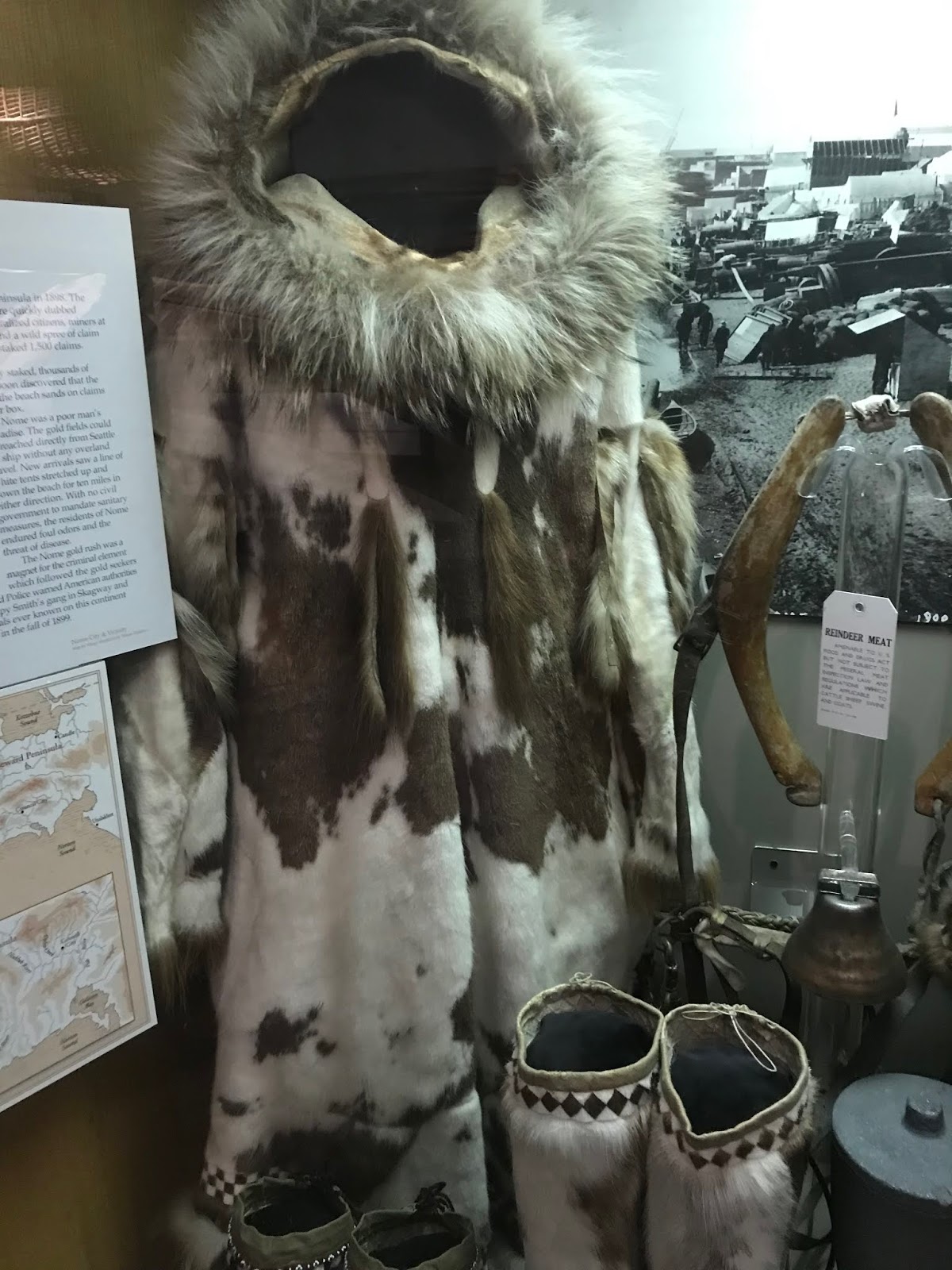
Eskimo gear

Walrus and seal

Polar Bear----closest I will EVER get

Also mentioned in the book was a fun activity that the Eskimo did, where they gather around and jump up and down on a framed hoop thing. If I show you a picture, I'm sure you'll remember your days in PE or Field Day this game as well. 
This was in the gift shop; notice, I just took a picture. It was WAY out of my budget to buy it.

And as a teacher I have been listening to my students each year read me the story of how animals adapt in the winter time; foxes use their tails to wrap around their heads, most animals grow a heavier coat, and birds grow feathers on their feet. Now I know that that's true. This is the ptarmigan, the state bird of Alaska. In the winter, it turns white for camouflage. And yes, it truly has feathers on its feet. Wowza!😃


There are lots of things to do in Fairbanks. There is an Ice Museum, including sculptures of ice, and they play music with a light show on the sculptures. We didn't see it, as we already did a lot. There is also a Dog Mushing Museum, free, that we chose not to go to as well. North Pole, Alaska, is only 10 miles in the other direction, and it has some cool things as well, but we chose to stay and visit the many things Fairbanks does well. 

We had a really good time here and glad that we stayed the two weeks. Most people come out here and only stay 2-4 days. What a shame! This place has so much to offer. And talk to the locals. They love to share with you. I hope you get a chance to come up here. The scenery is breathtaking. The weather is absolutely wonderful, and the mosquitoes really aren't that bad.......now. 😀 Thanks for visiting Fairbanks with me. It truly is a Heart of Gold city.
 😉


Friday, May 31, 2019

Chicken and Gold

Hi all! We finally made it to Alaska!

We are here until July 19 in various cities. We spent our first 5 nights in Tok, Alaska (pronounced Toke). There is not much there, the town hosts about 2600 people. About 2 hours away is the Top of the World Highway. That highway has limited access because it goes to and along the top of a mountain range. We decided to take it to a little junction city called Chicken. Check out my video:


After Tok, we traveled to Fairbanks. Not far from Fairbanks is the little village called

Yes, boys and girls, North Pole, Alaska does exist! It is 10 miles from our RV park and about 10 miles from Fairbanks, Alaska. We are staying at Riverview RV Park for about 2 weeks because we can. A lot of people are only staying for up to 4 days here only because they have to rush back out to the next place (usually Denali and then on to Anchorage). We figured we can hang around a little longer and "cool our jets." There is a lot to do here. There is Pioneer Park, a bunch of museums and so forth. Our neighbors next door typed us up an itinerary! That was very nice of them! They even included where to get my hair done (how did they know???) Anyhow, they both earn a little extra cash helping out the tour bus crowd downtown by giving them great places to go around here in Fairbanks. Hmm? Maybe I can do that one day and earn some yarn money? We shall see.....

One touristy thing I did was go gold panning with my travel buddy Melissa. We met in Whitehorse. She is from Houston, and she is traveling with her dog Tilly. We visited a gold dredge (called Gold Dredge 8) which was in commission until 1964. It was shut down because of EPA regulations. It produced over $1MIL in gold from 1934 to 1964. Not bad for a little place in Alaska!

So it was fun to take a train ride, walk around a gold dredge, learn how they got the gold out, and pan for gold. 


my pile of dirt; any gold in there??

add water and swirl

There's gold in that pan!!

All of those specks yielded 3 grams, which was about $18. Melissa only got about $6 worth. But it was a lot of fun. We got free cookies and hot cocoa/coffee, so you can't go wrong with that! It was a 3 hour tour, as far as the total package, so all in all it was a good day. 

They also told us about the pipeline, which runs in front of the area where you hop on the train. It runs 380 miles from Prudhoe Bay to the place where we picked up the train outside of Fairbanks, and then another 420 miles to the port at Valdez. Money was no object, so by the time the pipeline was finished in 1976, it cost $8 BILLION. Wow! But it puts out about 700K barrels of oil per day. That's pretty good. When it comes out of the ground, it is 110*F; by the time it finishes its run to the port, it is about 40*F. 


Every 6 days, they run these things through it, called a PIG. I don't know if it's a moniker for something, the guide didn't say (it probably stands for something). And every so often they run a SmartPIG (with digital instruments to check for leaks or damage in the pipe). The PIG goes through and cleans out paraffin, a by-product of petroleum. It is propelled by the petroleum. Who knew? As long as they don't put whistling pigs through it, we're okay 😆

We will be doing other things here in Fairbanks; as I said, lots of things to do. I will keep you posted.
 😉

Saturday, May 18, 2019

Wild Country Yukon

Hi all! One of the big attractions here is the Yukon Wildlife Preserve. For a very reasonable price (about $20 with the exchange rate) you can see various species of wildlife. They are doing such a remarkable job, zoos tell their people to come there to see what they are doing! Awesome-sauce 😊 It is about 5K (or about 3.1 miles) in distance. You can choose to walk it or take the bus; we chose to walk it (gotta get those steps)! It took about 2 hours because you have to stop and get your pictures. Some of them are so close, like the moose, you want to reach out and pet them, but uh-uh-uh! No petting aloud! They said no alcohol either. I joked that I couldn't have a glass of wine? She said no toasting with the moose. Apparently the moose has done it before 😂 AND we had a lovely weather day to do it, too.
So come along with me and see some wild animals!


A few days later, we visited the SS Klondike. It is a riverboat that went up and down the Yukon River from 1929-1955. It is made of Douglas Fir (a readily available resource), burned it too---one cord going down the river (with the current), three cords up the river (against the current). She mainly carried ore because of the gold rush, and then they found silver, so she carried that, too. Once the Alaska Highway came through, trucks were the preferred mode of transport, so she was put in the shipyard, drydocked, and became an historic site.

Her draft was only three feet/1 meter of water, and when she got stranded, it was usually a sandbar. The paddle was in the back, so she was a "sternwheeler" (back wheeler); which was good because any debris passing by was broken up by the bow of the ship instead.

She had a crew of 23 and hauled upwards of 64 passengers, but mostly it was ore. She ran to Dawson (or Dawson City) which up until 1959 was the capital of the Yukon, and back down to Whitehorse. The trip up was 1.5 days and the trip back was 3 days. The entire season of the riverboat was 4 months in the year.


The fire man stoked the furnace with wood. They only carried what they needed to get from Point A to Point B. The main job of the boat was ore; and ore meant profit. So every spare inch was for that purpose. The fire man put a log in every 30 seconds. He worked 4 hours on, 8 hours off. It was the most grueling job on the boat. This is the front of the firebox (at the bow of the boat)
the back (a giant cauldron, basically)

the engine room at the back of the boat (stern)

So, now that we've left Whitehorse, we head downriver to pick up the ore. This is what you get:

This is galena, a lead ore containing significant amounts of silver. They hauled bags of this stuff, weighing about 25 pounds (4 on a trolley). They were pretty "cut", wouldn't you say??
This man is demonstrating for us how it was hauled

each of these bags would contain 25 pounds of ore; they would be stacked along the side of the ship,
as much as it would hold.


This is the berthing for the general crew. They slept behind the engine room; very noisy, very hot.


stores for the crew and passengers

There was also berthing for first and second class passengers. They had a dining area, too. First class passengers had their own kitchen and dining hall. 


Second class passengers had their own kitchen as well. They, however, had to eat on the deck.


Along with passengers and crew, ore and logs for fuel, food and other what-nots, the boat carried mail and luggage for those who decided to move to Whitehorse.
actual mail bags from that time 
(hope there is not still mail in it)!

It was a great guided tour and reasonably priced ($6.10CD, $4.50 USD). Our guide was very knowledgeable, and today was the first day of the season. We had an excellent weather day, even if it was a little chilly (about 56 degrees). 

Thanks for coming with us. Hope to see you soon! 😉


Wednesday, May 15, 2019

Welcome to Canada, eh?

Hi all!
I know it's been a while since I posted. I had a post while we were in Clackamas, staying at a BnB while we were getting some upgrades to our house. But apparently it didn't take. Here are some before and after shots.
Before:  saggy upholstery

After:  nice, tight, new upholstery

Before:  unused space

After:  storage drawers and a new countertop

Before:  fiberglass sink

After:  stainless steel sink (and it's deeper, too!)

All in all, the upgrades were well worth the wait. I was sooooo happy to get my house back and sleep in my own bed again!

After we got our house, we headed out of Clackamas, Oregon straight on the road north. After a few days, we arrived at the beginning of the Alaska Highway here at Dawson Creek, BC. Check out the video all about it.

The next stop was Fort Nelson, where we spent two days chilling out and washing the dust off of the trailer. After that, we headed towards Whitehorse, Yukon Territory. Along the way, we stopped for the night in Watson Creek at Tags' RV Park. Across the street from Tags is a popular tourist destination:

This was all started when a GI working on the Alaska Highway made a sign for his hometown of Danville, Illinois. Others began making one for their hometown as well, and a tourist attraction was born! They encourage people who are coming this way to bring one of their own. Or, you can buy one and make it to put up. Me, I just took pictures. Those are free!


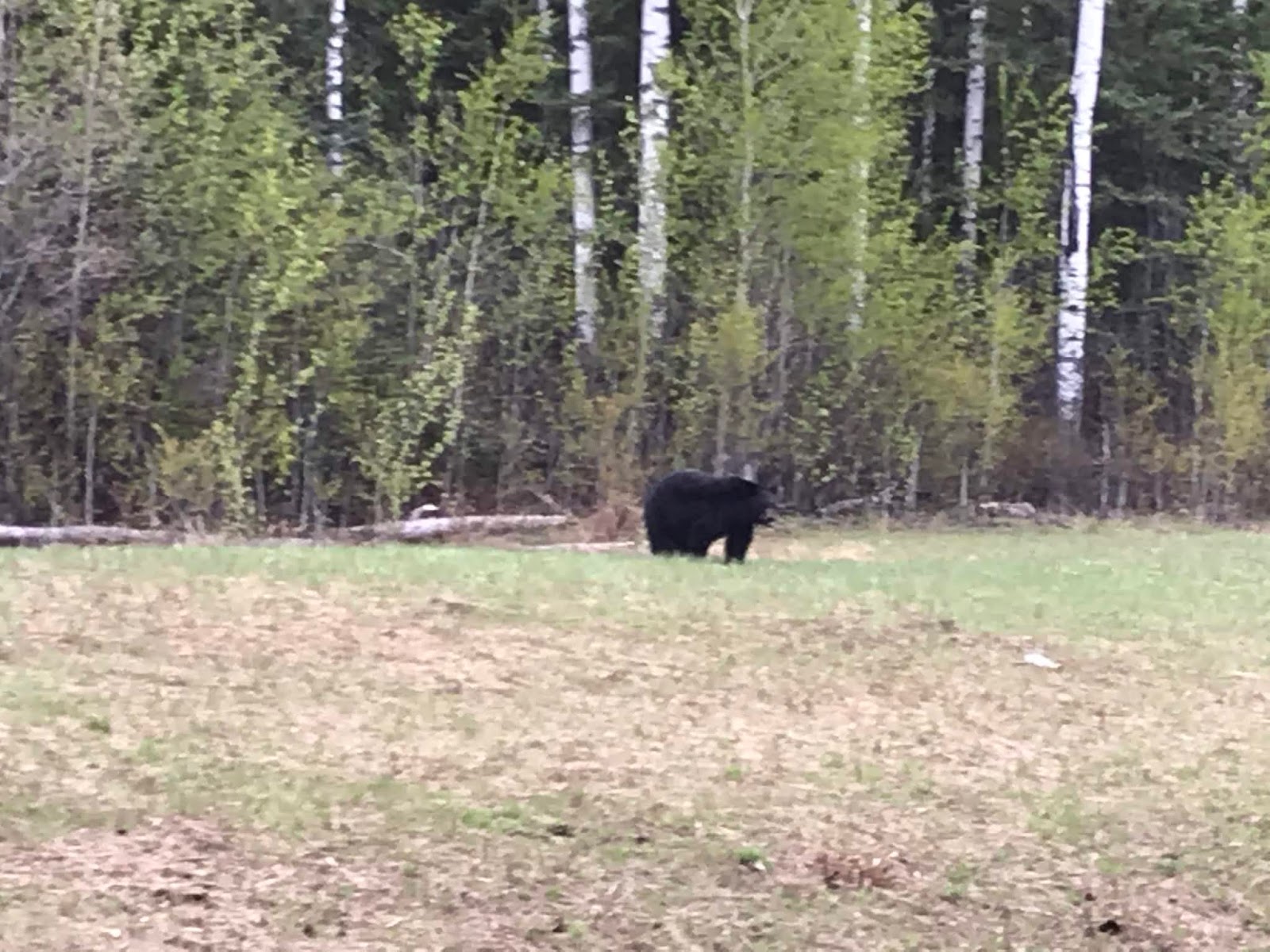
There are signs along the Alaska Highway, too, warning you of the dangers of wildlife hanging about. There are moose, caribou, bear, and wood bison in these areas from British Columbia through the Yukon. Sometimes there are big horn sheep. We only saw bear, moose, and bison. They are on the side of the road, so if you are the only car, you can pull off and take a quick picture. If not, you need to snap on the go. Them's the rules here.
Anyone got a bologna sandwich?

Ahh.....look at those beautiful mountains!

A girl Moose-ski (I had to be quick! As soon as she heard the truck, she turned and ran away)

Wood Bison
See? Literally on the side of the road!

And don't forget there was also beautiful scenery as well: mountains and lakes and valleys. Enjoy! Ya'll come back! 😉